
Musculoskeletal (MSK) AI Product
Enhancing quality of life for seniors: discovery research for an AI-powered digital assessment and self-management product.

Introduction
This case study covers my role as Lead UX Researcher during the discovery phase for a voice-enabled, AI-powered digital assessment and self-management product — designed to support people aged 55 and above in self-assessing and managing musculoskeletal (MSK) conditions.
My responsibilities spanned the full research process: reviewing existing academic literature, synthesising findings, identifying initial archetypes and opportunity areas, creating discussion guides, conducting end user and stakeholder interviews, facilitating co-design workshops, and journey mapping and facilitating co-design workshops, and journey mapping.
Client: NDA
Role: Lead UX Consultant
Review of Existing Academic Literature
Before speaking to a single user, I conducted a structured review of existing academic literature to establish an evidence base for the research. The focus was on understanding what influences older adults' acceptance of new technology, their attitudes and barriers to adoption, and what the evidence says about voice assistants in healthcare contexts.
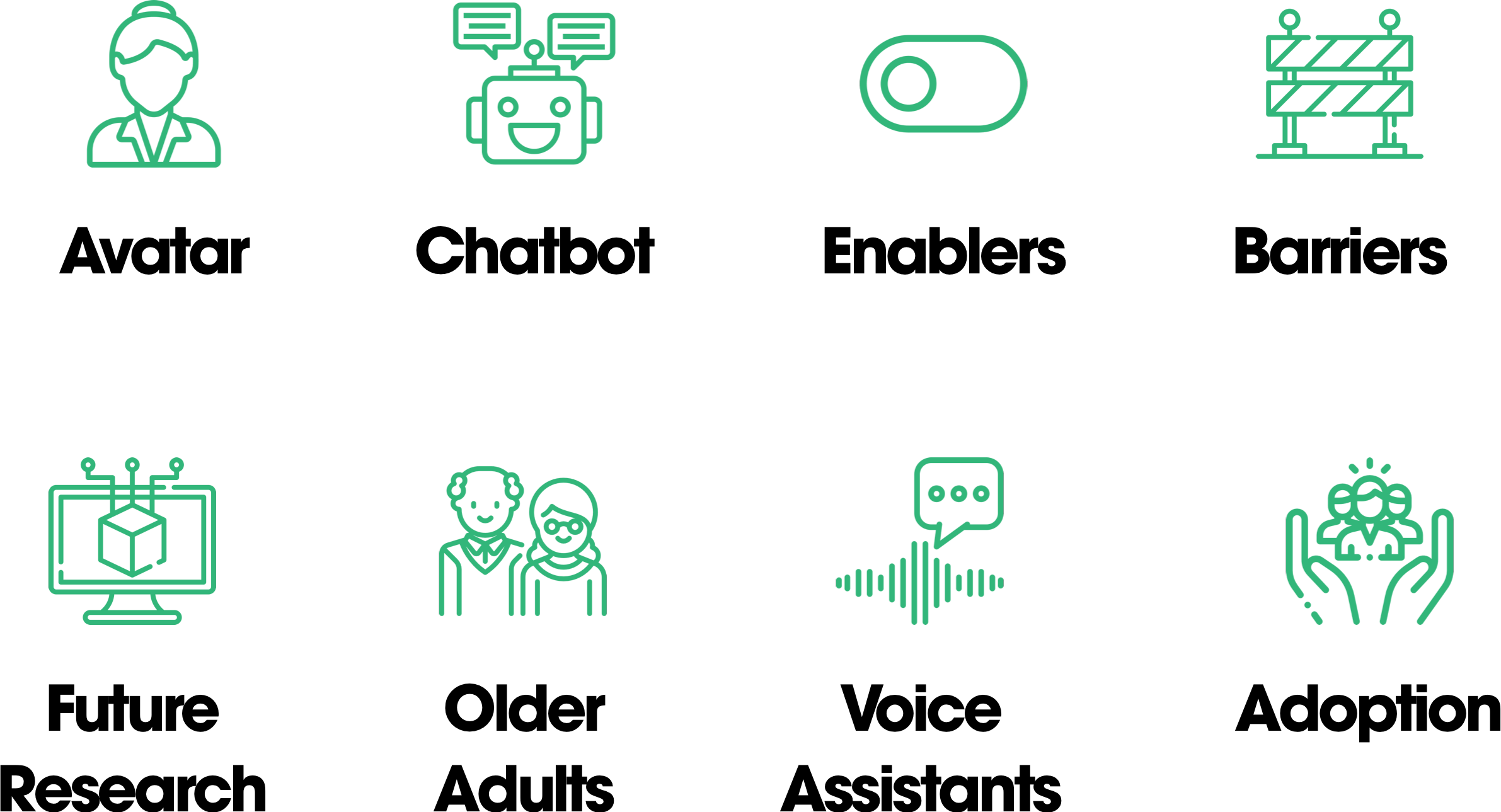
Over 150 insights were organised into eight concept areas — avatar, chatbot, enablers, barriers, future research, older adults, voice assistants, and adoption — forming a foundation that shaped every subsequent stage of the research.
Universal Barriers to Access
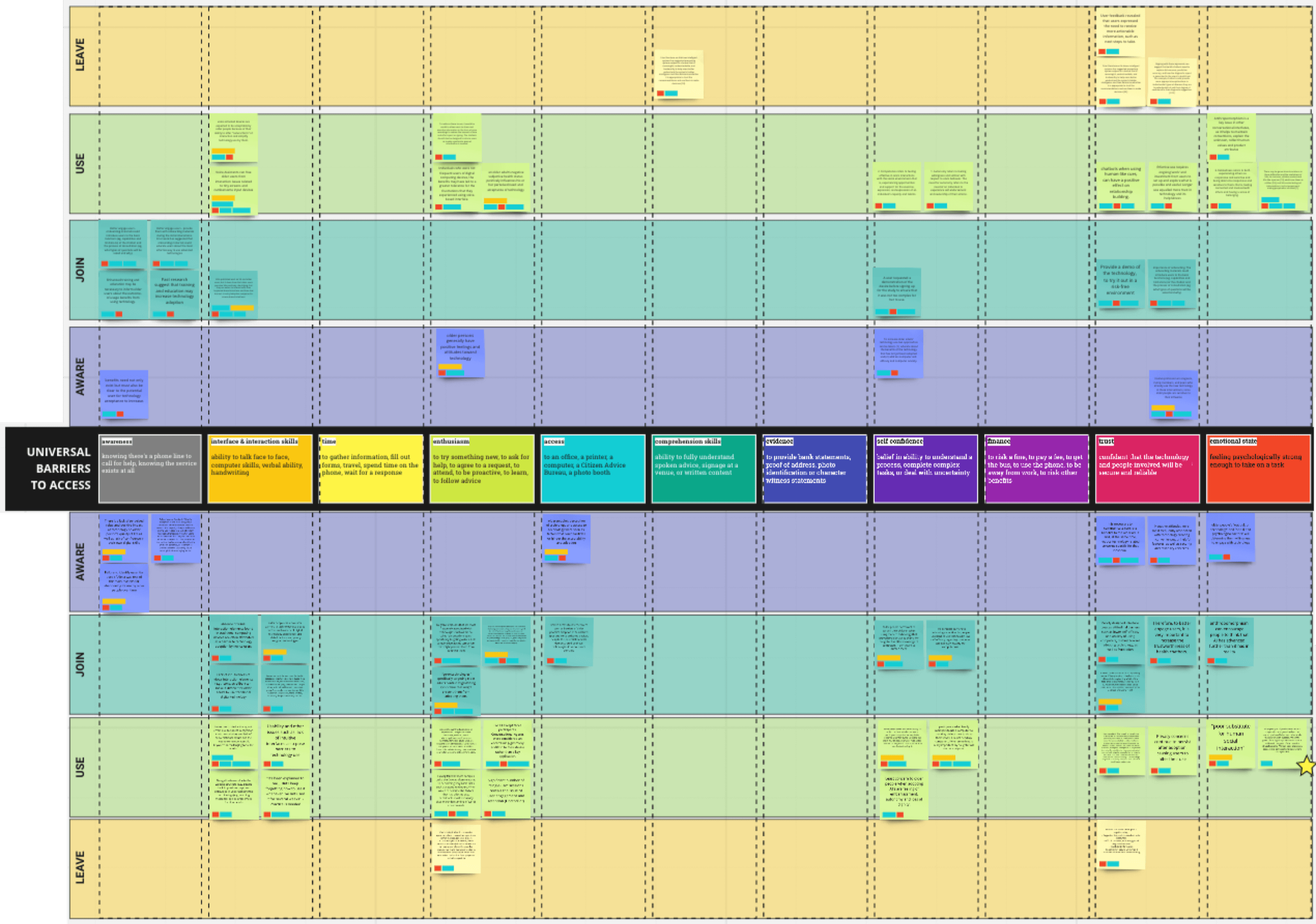
The next stage was mapping universal barriers to access using a framework developed in collaboration with the Government Digital Service — a more inclusive and rigorous approach than assuming barriers based on demographics alone. Of the twelve universal barriers identified, nine were relevant to this product: including awareness, digital confidence, trust, and motivation to engage.

Service Journey
Each stage of the service journey — from first awareness of the product through to leaving — was reviewed and mapped. Insights were organised into enablers and barriers at each touchpoint, giving the team a clear picture of where the product could add value and where it risked losing people.

End User Interviews & Discussion Guide
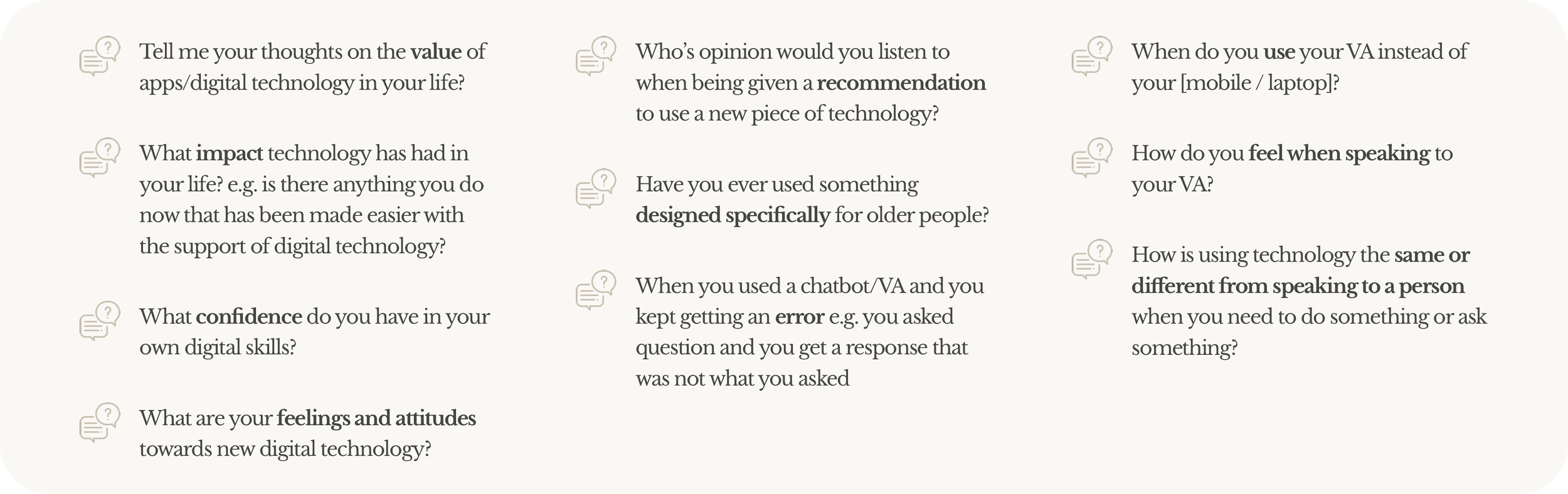
The literature review and barrier mapping directly informed the discussion guide for user interviews — ensuring conversations were focused, evidence-led, and targeted at the areas of greatest uncertainty. Participants reflected a mix of genders, technology confidence levels, and prior experience with voice assistants.

Sessions explored the value of digital technology in participants' lives, their confidence and attitudes towards health tech, and — critically — how interacting with a voice assistant compared emotionally to speaking to a person. Understanding that emotional dimension was essential for a product where trust is a prerequisite for use.
Synthesis, Initial Archetypes, and Opportunity Areas Identified
From the literature review and interviews, I synthesised findings into three user archetypes representing the distinct needs, behaviours, and outlooks encountered across the research. These were designed as practical design tools — not rigid personas, but a usable guide to the typical traits and needs of a complex audience — directly informing design decisions and opportunity areas for the product.

Facilitation of Co-design Workshops
I facilitated a series of co-design workshops with participants aged 55–75, who had recent GP contact and a mix of technology confidence levels. Working through scenarios at each stage of the service journey, I asked participants to articulate what they would do, think, feel, and what could be better — generating rich qualitative data directly from the people who would use the product.
Journey Mapping
Journey mapping exercises visualised the end-to-end user experience, highlighting key touchpoints, emotional responses, and pain points throughout. This gave the team a shared understanding of the experience from the user's perspective — and identified the moments where the design needed to work hardest.
Key findings
1. Participants valued the product feeling more personal than NHS websites
2. Given long NHS waiting times, many saw it as a legitimate alternative pathway for triage and assessment
3. Users felt it would reduce the burden on clinicians by handling initial triage — which can take over an hour
4. The ability to go at their own pace, and pause and return, was consistently valued across all participant groups
Conclusion
This project demonstrated the value of rigorous, evidence-led UX research in health technology — particularly for audiences where trust, digital confidence, and accessibility are make-or-break factors.
By grounding every stage of the discovery in both academic evidence and real user insight, the research produced a clear, defensible foundation for a product designed to genuinely improve outcomes for older adults managing MSK conditions.